TPG Investor Overview

TPG FAQ

When was TPG founded?

TPG was founded in 1992.

What type of investor is TPG?

TPG is a private equity firm.

Where is TPG headquartered?

TPG is headquartered in Fort Worth, Texas.

How much capital does TPG have under management?

TPG has 296.0B USD under management.

Sign-up to view TPG’s full profile and discover more mega-sized private equity firm investors just like it.

TPG

TPG, Inc.

301 Commerce St., Suite 3300,
Fort Worth, Texas 76102
United States
(817) 871-4000
www.tpg.com
inquiries@tpg.com

TPG Capital is a global, mega-sized private investment firm that manages a family of funds focused on private equity, real estate, venture capital, public equity and debt investing. TPG invests in opportunities across a broad range of industries and geographies. TPG generally seeks to invest in established businesses that can benefit from the Firm's operational experience and connections. Industries of interest include consumer, retail, healthcare, industrials, digital media, natural resources, energy, real estate, technology, and software. TPG was formerly known as Texas Pacific Group and was originally established in 1992 by David Bonderman, James Coulter and William Price. The Firm is based in Forth Worth, Texas with additional offices in Europe, Asia, and Australia.


Investment Criteria

Sectors of Interest: Aerospace, Airlines, Apparel/Textiles, Automotive, Beverages, Building Materials, Business Services, Chemicals, Communications, Consumer Products, Consumer Services, Digital Media, Distribution, Electronics, Energy Services and Equipment, Environmental, Financial Services, Food, Franchising, Gaming, Healthcare Services, Information Technology, Infrastructure, Insurance, Internet Software and Services, Leisure, Life Science, Manufacturing, Media, Medical Products, Metals/Mining, Oil/Gas Exploration, Packaging, Plastics, Publishing, Real Estate, Renewable Energy, Restaurants, Retail, Safety/Security, Semiconductors, Software, Technology Hardware, Test/Measurement Equipment, Transportation, Utilities

Target Transaction Types: Buyout (LBO, MBO, MBI), Consolidation, Divestiture, Going Private, Growth Capital, Recapitalization, Special Situations/Distressed, PIPE, Secondary Buyout, Stake Purchase, Venture

Geographic Preferences: East US, Midwest US, South US, West US, Canada, United Kingdom, Western Europe, Eastern Europe, Nordic, Asia/Pacific, Australia/New Zealand, Latin/South America

Transaction Criteria Min Max
Target Revenue - -
Target EBITDA - -
Investment Size 10 1,000
Enterprise Value - -
values in millions of USD


Try Mergr Free — See This and 220,453+
Other Company and Investor Profiles Today

Try free. Full access. Cancel anytime.

  • check  Unlimited Searches
  • check  Unlimited Profile Views
  • check  Build and Export Lists of
    • PE Backed Companies
    • Direct Investors & Acquirers
    • Advisors
    • Deals
    • & More

What's Mergr?

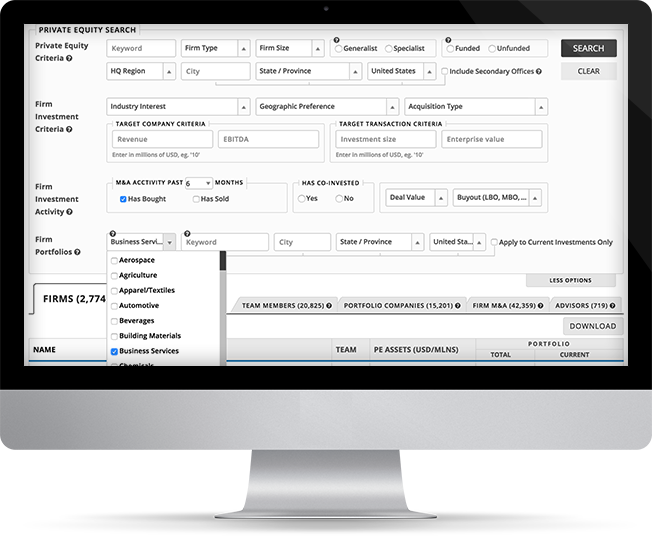
Mergr is a user-friendly database designed to simplify the complex world of private equity and M&A for busy professionals.

We created Mergr to eliminate the challenge of tracking company acquisitions, sales, and ownership, providing clear insights into investment firms and their activities. For example, explore an investment firm’s investment criteria, deal history, portfolio, and connections - organized to help you uncover opportunities and make informed decisions.

With Mergr, gain access to a comprehensive, interconnected web of transactions, investors, companies, and advisors - all in one place.

Mergr, the Easiest-to-Use PE and M&A DB


Key Benefits

  • Stay informed on events in your industry
  • M&A research that takes seconds (not all afternoon)
  • Better understand your customers and prospects
  • Discover active buyers (or sellers)
Search
  • 4.8K Private Equity Firms
  • 214K M&A Transactions
  • 216K Companies Involved in M&A
    (Buyer, Seller, or Target)
  • 3.8K M&A Advisors
    (Investment Banks and Law Firms)
  • 82K M&A Contacts
    (PE and M&A Advisors)

What next?

Try Free

Full access to Mergr's investor, acquirer, and transaction data starts here.